
NGC 2634 galaxy group + Massimo Di Fusco + L-QEF (L-Quad Enhance Filter)
NGC 2634 galaxy group
Credit: Massimo Di Fusco
Filters: Optolong L-QEF (L-Quad Enhance Filter)
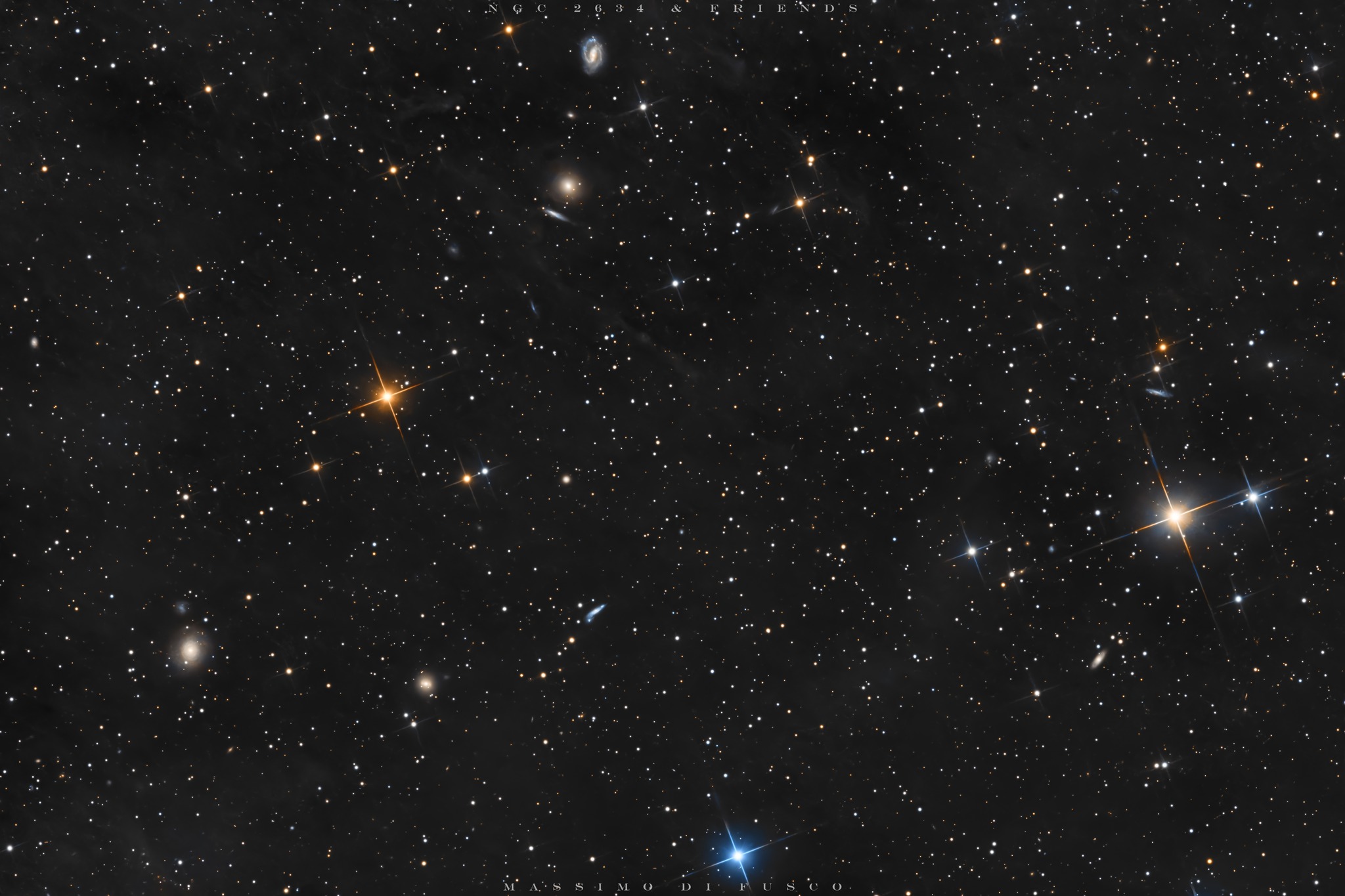
This cosmic picture in the constellation of Giraffe can be divided into three main areas.
At the top centre is the NGC 2634 galaxy group, a cluster of galaxies located about 106 million light-years from the Milky Way and comprising at least five members, including the magnificent NGC 2633 galaxy. These galaxies share similar radial velocities, suggesting that they are gravitationally bound and form a coherent group.
Discovered on 11 August 1882 by German astronomer Ernst Wilhelm Leberecht Tempel, NGC 2634 is classified as type E1 according to Hubble's classification. It has an apparent magnitude of about 12.0 and an estimated diameter of 90,000 light years.
Right next to it is NGC 2633 (Arp 80), which ranks second among the galaxies in the group. It is an SBB barred spiral galaxy with an apparent magnitude of about 12.7 and an estimated diameter of 69,000 light years. Its structure features a central bulge with spiral arms, typical of SBB galaxies, and its galaxy-rich environment suggests gravitational interactions.
The field of view of the NGC 2634 group is enriched by the presence of IFN (Integrated Flux Nebula), a diffuse structure of interstellar dust illuminated by the combined light of the stars of the Milky Way.
At the bottom left, we find a series of smaller galaxies.
IC 520 is an intermediate spiral galaxy (type SABa) about 173 million light years away from us.
NGC 2646, part of the IC 520 Group, is a lenticular galaxy about 179 million light years from our Milky Way, discovered on 27 July 1883 by the German astronomer Wilhelm Tempel. On 1 September 1888, the galaxy was observed again by the American astronomer Lewis Swift; and its description was included in the Index Catalogue with the code IC 511. However, the identification of IC 511 with NGC 2646 only took place recently, on 21 August 2017. Previously, it had been identified as PGC 24397.
IC 2389 is a Hubble-type barred spiral galaxy discovered by Guillaume Bigourdan on 3 February 1894. It is estimated to be 112 million light-years from the Milky Way and has a diameter of about 45,000 light-years. It probably forms a gravitationally bound pair with NGC 2636 (just above in the photo), a small elliptical galaxy about 102 million light-years away from us.
Finally, on the right, we find IC 511 (a lenticular galaxy about 176 million light-years away) and other remote galaxies, catalogued as PGC, hundreds of millions of light-years away.
Konus 200/1000 @950mm, f/4.8
Player One Poseidon-C camera @-5 °C
Sky-Watcher Eq6r Pro mount
Optolong L-Quad Enhance filter 388x180"
N.I.N.A., APP, PixInsight, PS
Ferrara (Italy)
Hope you like it.