
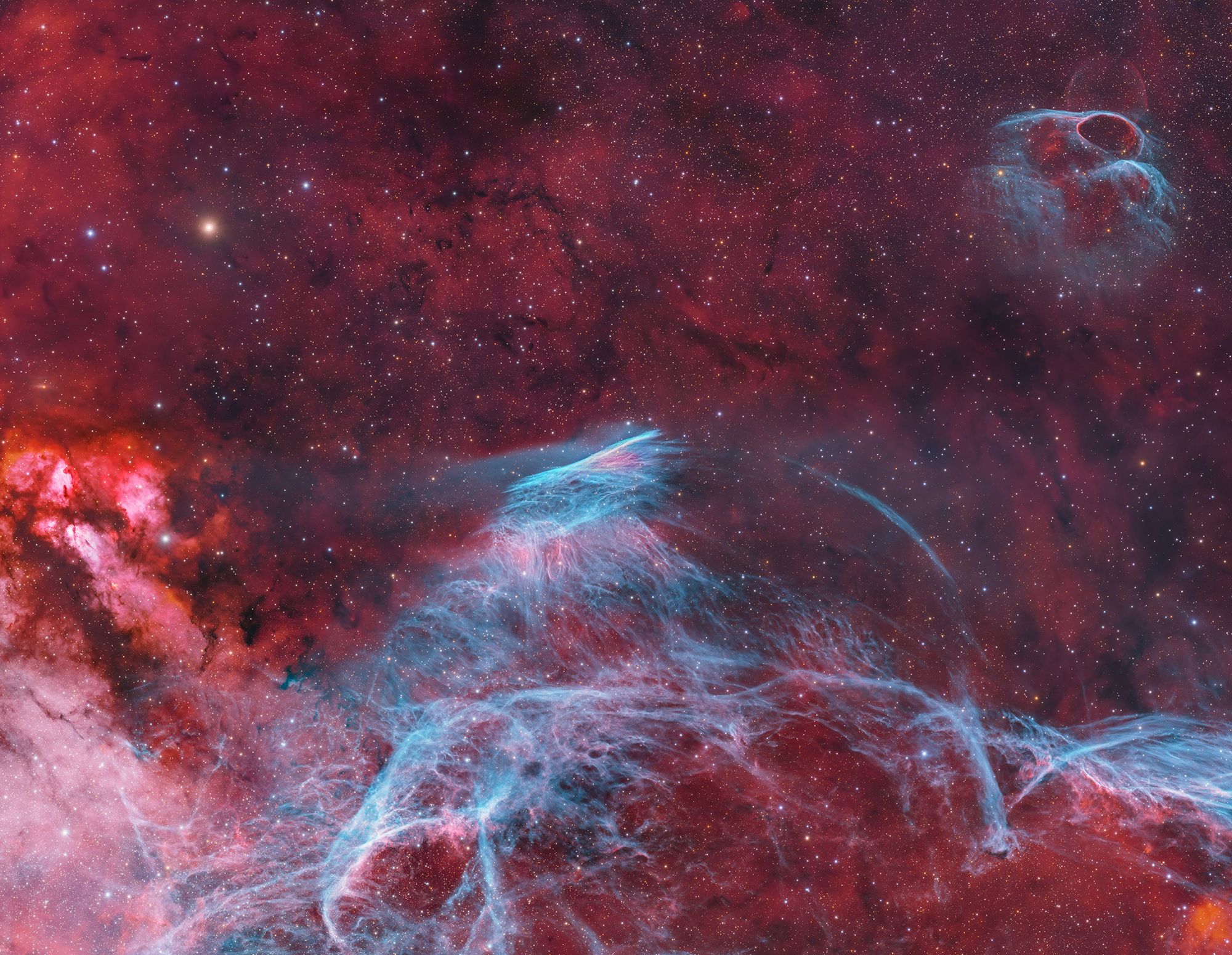
A mosaic of two images in the constellation Vela + Team Echoes of the South + LRGB, OIII3, HA3
A mosaic of two images in the constellation Vela
Credit: Team Echoes of the South
Filters: Optolong LRGB, Optolong OIII3nm, HA3nm narrowband
This is a mosaic of two images in the constellation Vela, where the Pencil Nebula (NGC 2736) can be seen in the centre, as if resting on the filaments of the Vela supernova remnant.
The Vela XYZ supernova remnant is now considered one of the closest and most studied objects of its kind in our Galaxy.
The explosion that created the SNR occurred around 11,000 years ago, likely resulting from a Type II supernova caused by the collapse of the core of a massive star.
The Pencil Nebula (NGC 2736) and the NilAdh Bubble (OED1).
Discovered in 1835 by John Herschel, it owes its name to its very elongated and slender shape, reminiscent of a pencil stroke.
Physically, this nebula corresponds to a localised portion of the shock wave from the remnant colliding with a denser region of the interstellar medium.
This interaction is crucial: it compresses, heats and then cools the gas, producing the observed light emission.
Observations reveal a wavy, layered structure viewed in cross-section, composed of filaments, bright knots and diffuse gas.
At the top right of this field, there appears to be an isolated, distinct object. In reality, this is still part of the Vela Supernova Remnant, but there is a peculiarity at its tip…
The bubble you see above the filaments is a beauty bestowed upon us by nature, but it is also, and above all, the result of an amateur discovery: OED 1 (Object Erkaslan-Drechsler 1), also known as “The NilAdh Bubble”.
This unclassified object could be a planetary nebula, but the typical central star is absent (no trace of a white dwarf).
One possible explanation is that the star has already disappeared and that the bubble is the only remaining trace of it.
Similarly, it could be the result of a nova, but here again, no central star has been identified to date.
At present, there is no clear evidence to determine the nature of this object.
Exifs and equipment:
Optolong Red 2": 149×120,″(4h 58′)
Optolong Green 2": 151×120,″(5h 2′)
Optolong Blue 2": 160×120,″(5h 20′)
Optolong H-Alpha 3nm 2": 195×600″ (32h 30′)
Optolong OIII 3nm 2": 102×600″ (17h)
Total exposure time: 64h 50′
Takahashi FSQ85-EDX
SkyWatcher AZ-EQ6 GT
Player One Astronomy Poseidon-M camera
Pixinsight & Photoshop for post-processing
Clear skies to all,
Team Echoes of the South
Photos by Cédric, Louis, Christophe, Nico
Hope you like it.